
Cancer research is increasingly driven by complex datasets generated from genomics, transcriptomics, proteomics, medical imaging, digital pathology, single-cell technologies, and clinical research. Bioinformatics provides the computational methods needed to process and interpret these datasets, while artificial intelligence and machine learning can help researchers identify patterns across large and multidimensional datasets. Together, these approaches are contributing to the growing field of computational oncology, where biological and clinical information is analyzed computationally to investigate cancer development, tumor heterogeneity, biomarkers, disease progression, and treatment response.
AI, Multi-Omics and Cancer Biology
Modern cancer research increasingly combines multiple molecular layers, including genomics, transcriptomics, proteomics, epigenomics, and metabolomics. This multi-omics approach provides complementary information about tumor biology, but integrating these datasets can be computationally challenging. AI and machine-learning methods are being investigated as tools for identifying relationships between molecular layers, classifying cancer subtypes, discovering biomarkers, and investigating complex biological patterns. Recent tools such as Flexynesis demonstrate how deep-learning approaches can be applied to bulk multi-omics datasets for cancer research.
figure 1 : the figure below shows the different types of machine learning models

AI in Single-Cell and Spatial Cancer Research
Single-cell and spatial technologies are generating increasingly detailed information about the cellular organization of tumors. Single-cell approaches can reveal different cancer-cell states and immune or stromal populations, while spatial methods preserve information about where these cells and molecular signals are located within tissue. AI and computational methods can help researchers analyze these high-dimensional datasets, identify cellular patterns, integrate multiple measurements, and investigate cell–cell interactions within the tumor microenvironment. The combination of single-cell, spatial, and computational approaches is therefore becoming an important part of modern cancer research.
figure 2 the figure below shows the Multiomics which analysis integrates data from cellular components such as genomics, epigenetics, transcriptomics, proteomics, and metabolomics, utilizing diverse modalities including bulk, single-cell, spatial, and imaging approaches (e.g., histopathology). This approach has significantly advanced key areas of cancer research, as highlighted in this review, including early detection, biomarker identification, patient stratification, drug response modeling, drug discovery, and AI-driven diagnostics. The figure illustrates how AI enhances multiomics analysis and its transformative impact on these domains.

AI in Computational Pathology and Multimodal Research
Artificial intelligence is also being applied to digital pathology and multimodal cancer research. Deep-learning models can analyze whole-slide pathology images to investigate tissue structure, tumor regions, cellular patterns, and molecularly relevant features. At the same time, researchers are combining pathology, imaging, clinical information, and molecular data to study cancer from several perspectives at once. These approaches may help reveal relationships that are difficult to detect when each data source is analyzed separately.
Nature Medicine — Computational Pathology Foundation Model
Nature Cancer — Multimodal Real-World Data and Explainable AI
AI, Biomarkers and Precision Oncology
Computational approaches are also being explored for cancer biomarker discovery and precision oncology. By combining genomic, transcriptomic, imaging, pathology, and clinical information, researchers can investigate molecular or cellular features associated with tumor characteristics and treatment outcomes. AI can help detect complex patterns across these datasets, but computationally identified signals still require biological interpretation, independent validation, and careful evaluation before they can be considered reliable biomarkers or translated into clinical applications.
Data Quality, Bias and Explainability
The success of computational oncology depends not only on sophisticated algorithms, but also on high-quality, representative, and carefully validated datasets. Differences in patient populations, experimental methods, imaging systems, sequencing technologies, and data annotation can influence model performance and generalizability. Research in computational pathology has demonstrated demographic performance differences between groups, highlighting the importance of representative datasets and external validation. Explainable AI is another important area, as researchers seek ways to better understand which biological, imaging, or clinical features contribute to computational predictions.
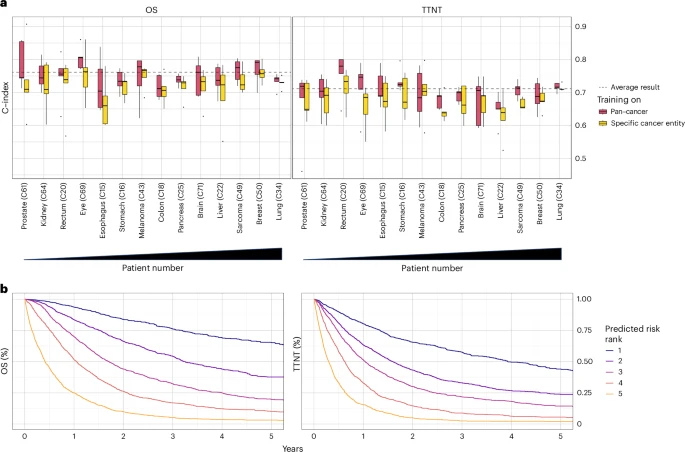
figure 3: The figure shows how a neural network was evaluated across different cancer types and how patients could be grouped according to their predicted risk. The results illustrate how computational models can use clinical and molecular information to identify patterns associated with overall survival and treatment outcomes across multiple cancers.
Generative AI and the Future of Computational Oncology
Generative AI and large language models are beginning to influence bioinformatics and biomedical research workflows, with potential applications involving scientific literature, biological knowledge, programming, data analysis, and interaction with computational tools. More broadly, computational oncology is moving toward greater integration of AI, bioinformatics, genomics, multi-omics, single-cell analysis, spatial biology, digital pathology, imaging, and clinical data. The objective is not simply to process larger quantities of information, but to connect different biological layers and generate new, testable insights into cancer.
Conclusion
AI, bioinformatics, and computational oncology are expanding how researchers investigate cancer across molecular, cellular, and clinical levels. By connecting genomics, multi-omics, single-cell and spatial data, digital pathology, imaging, and clinical information, computational approaches can help researchers identify complex biological patterns and generate new hypotheses about tumor development, heterogeneity, biomarkers, and treatment response.
As these technologies continue to evolve, data quality, validation, transparency, and biological interpretation remain essential. The future of computational oncology will increasingly depend on combining advanced computational methods with reliable biological research to build a deeper and more integrated understanding of cancer.
Cura Cancer explores these connections across modern cancer research, bringing together scientific concepts, research technologies, and emerging approaches to help readers understand how data-driven methods are shaping the study of cancer.